

Reviewed By: Dr. Bradley Middaugh
Table of Contents
Yes. Lazy eye, or amblyopia, can often be improved in children, especially when treatment begins early. Lazy eye treatment for children may include prescription glasses, patching, atropine eye drops, newer digital therapies, or treatment for an underlying eye condition. The right approach depends on the cause and severity.
Amblyopia can be easy to miss because a child may rely on the stronger eye and never complain that anything looks blurry. Routine vision screening and a complete eye exam matter when you have concerns about how a child sees or uses both eyes together.
What Is Amblyopia and Why Does It Happen?
Amblyopia develops when the brain and an eye do not work together normally during childhood visual development. Over time, the brain relies more heavily on the eye that provides the clearer image, and vision in the other eye may remain reduced. The National Eye Institute describes amblyopia as the most common cause of vision loss in children.
Amblyopia is sometimes confused with strabismus, but they are different conditions. Strabismus refers to eye misalignment. It can cause amblyopia, but a child can also develop amblyopia without an obvious eye turn.
How Do Refractive Errors and Eye Misalignment Cause Amblyopia?
A significant difference in prescription between the two eyes can cause refractive amblyopia. If one eye consistently sends a blurrier image, the brain may begin favoring the clearer eye.
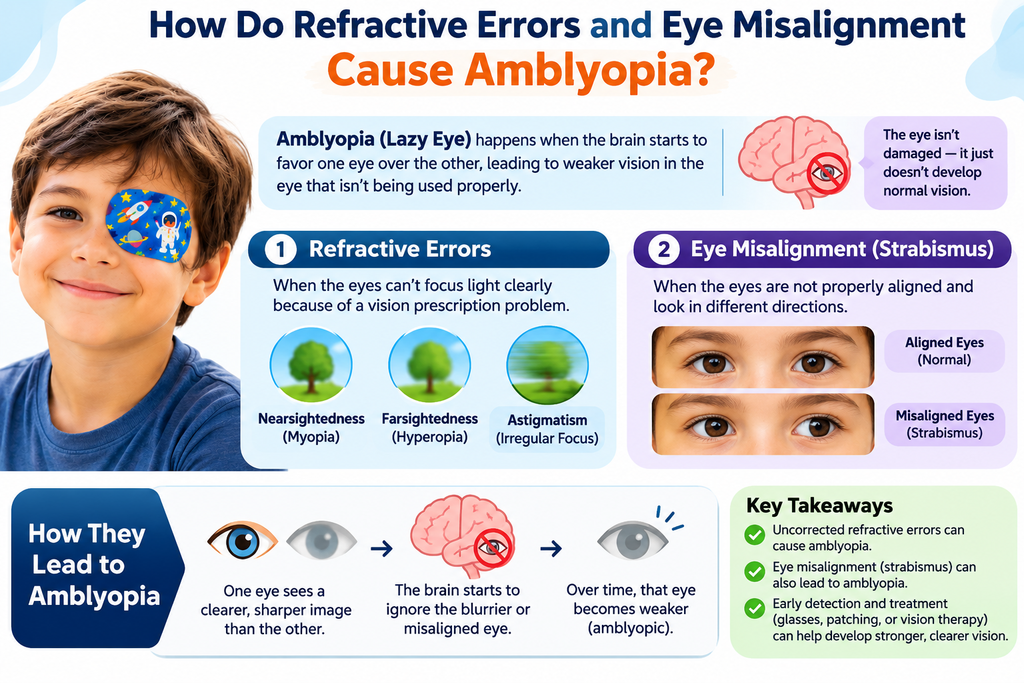
Strabismic amblyopia develops when the eyes do not point in the same direction and the brain suppresses input from one eye. Less commonly, a cataract, severe drooping eyelid, or another obstruction can interfere with visual development and cause deprivation amblyopia.
Can Lazy Eye Be Corrected?
For many families, the central question is “can lazy eye be corrected?” In childhood, treatment can often improve vision substantially, although the amount of improvement varies. The goal is to correct the problem causing unequal vision and encourage the brain to use the weaker eye more effectively.
Earlier treatment generally gives the developing visual system more opportunity to respond, but age should not be treated as an absolute cutoff.
Why Does Early Amblyopia Treatment Matter?
The connections between the eyes and brain are still developing in childhood. Treating amblyopia during that period can help the weaker eye participate more fully in vision.
Mayo Clinic notes that the best results generally occur when treatment begins before age 7. That does not mean treatment suddenly stops working at that birthday.
Can Older Children Still Benefit From Treatment?
Yes. The American Association for Pediatric Ophthalmology and Strabismus (AAPOS) notes that NIH-supported studies found treatment can still improve vision in younger teenagers, including children up to age 14. However, treatment tends to work better at younger ages.
An eye doctor can evaluate the child’s vision and determine which amblyopia treatment options are appropriate.
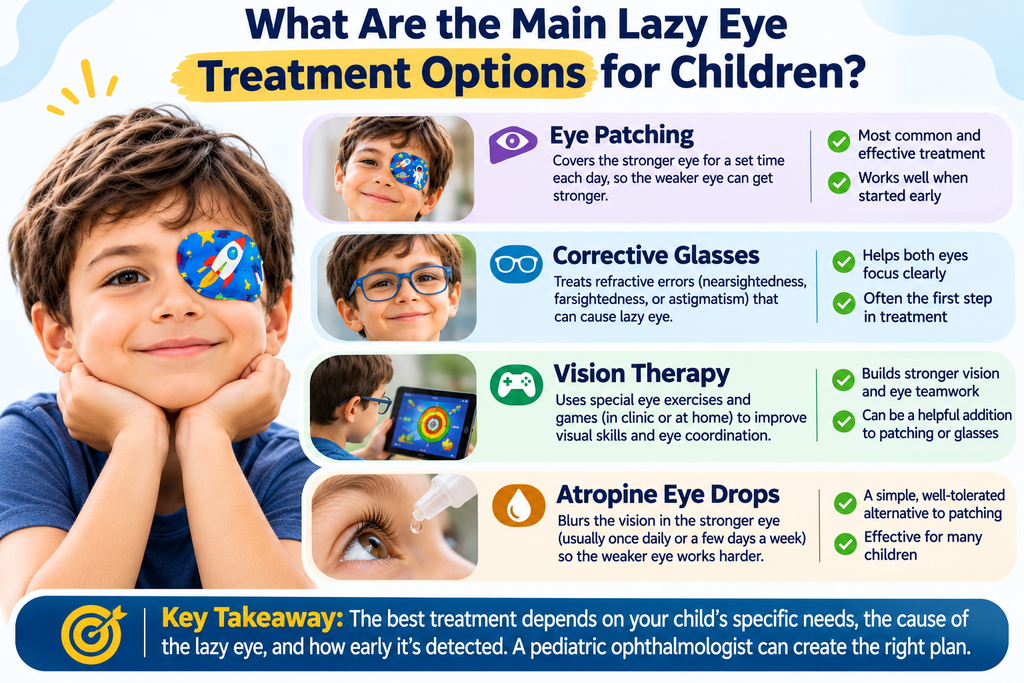
What Are the Main Lazy Eye Treatment Options for Children?
Treatment depends on the cause of amblyopia. Some children improve after correcting the underlying vision problem, while others need treatment that reduces reliance on the stronger eye. Follow-up exams help the eye doctor adjust the plan as vision changes.
Can Glasses Correct Amblyopia?
Prescription glasses or contact lenses may be the first step when refractive error contributes to amblyopia. Giving each eye the clearest image possible allows the doctor to see how much vision improves with optical correction alone.
Some children improve enough with glasses that additional treatment is limited or unnecessary. Others still need patching, drops, or another therapy, according to AAPOS.
How Does Eye Patching Treat Lazy Eye?
Patching covers the stronger eye so the brain relies more on the weaker eye. AAPOS recommends a patch that blocks the eye completely because children can often peek around loose or elastic patches.
The number of hours varies with the child’s vision and treatment history. Parents should follow the schedule prescribed by the child’s eye doctor.
When Are Atropine Eye Drops Used for Amblyopia?
Atropine temporarily blurs vision in the stronger eye, encouraging greater use of the weaker eye. For some children, it can provide an alternative to patching.
Atropine does not work equally well for every type or severity of amblyopia. Light sensitivity and eye irritation can also occur.
When Do Digital Treatments or Surgery Fit Into Amblyopia Care?
FDA-cleared digital therapies are another option for certain children. These systems use specially designed visual content to change how the two eyes contribute during treatment. AAPOS notes that researchers are still studying these newer approaches to understand which children benefit most.
Surgery may be needed to remove a cataract, correct a drooping eyelid, or address persistent eye misalignment. It treats the physical problem contributing to amblyopia, while glasses, patching, drops, or another therapy may still be needed afterward.
What Happens If Lazy Eye Is Left Untreated?
Amblyopia usually does not resolve simply because a child gets older. If the brain continues relying primarily on the stronger eye during visual development, reduced vision in the weaker eye can persist.
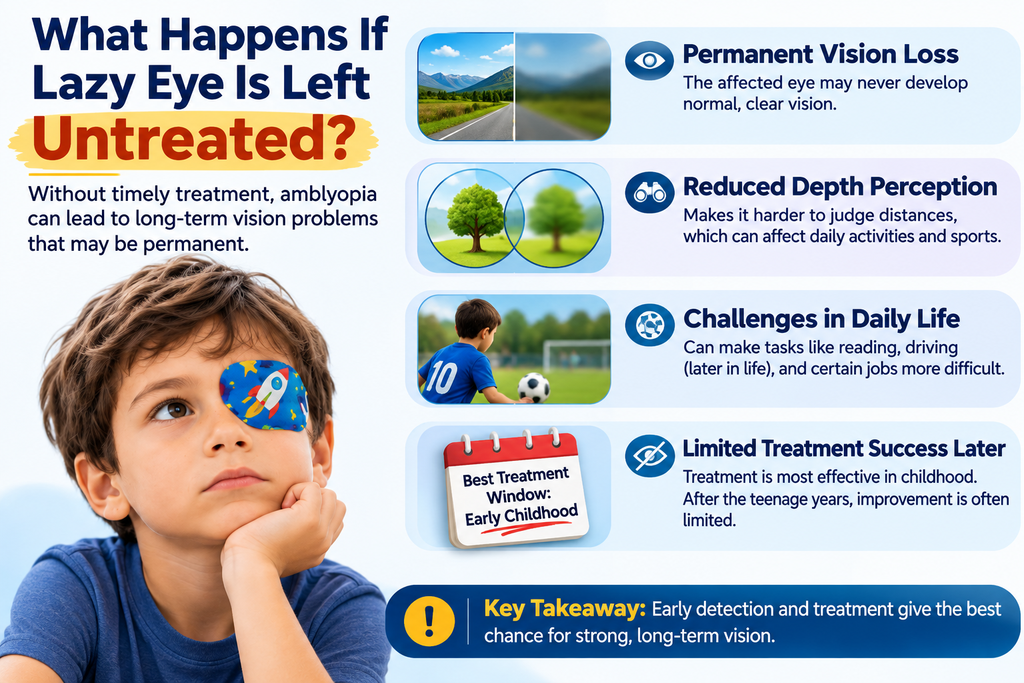
Some children have few noticeable symptoms. Squinting, closing one eye, unusual head positioning, poor depth perception, or an eye that wanders can all warrant an eye evaluation.
Families concerned about these signs can learn more about Center For Sight’s children’s vision care and available eye evaluations.
Key Takeaways
- Lazy eye treatment for children works best when amblyopia is identified and addressed early.
- Glasses may be enough for some children, while others need patching, atropine drops, or another treatment.
- Older children can still benefit from treatment, so age 7 should not be treated as a hard cutoff.
- Surgery may address an underlying cataract, eyelid problem, or eye misalignment, but additional amblyopia therapy may still be needed.
- Regular follow-up helps the eye doctor track improvement and adjust treatment when needed.
Frequently Asked Questions
How Long Does Amblyopia Treatment Take?
u003cspan style=u0022font-weight: 400;u0022u003eSome children begin improving within a few weeks, but reaching the best result often takes months or longer. The timeline depends on the cause and severity of amblyopia, age, and how consistently the treatment plan is followed.u003c/spanu003e
What If My Child Refuses to Wear an Eye Patch?
u003cspan style=u0022font-weight: 400;u0022u003eIf your child resists patching, AAPOS suggests rewards or pairing patch time with a favorite activity. If that doesn’t help, ask their eye doctor about alternatives.u003c/spanu003e
Can Lazy Eye Come Back After Treatment?
u003cspan style=u0022font-weight: 400;u0022u003eIt can. Children may need continued monitoring after vision improves, and some may use lower-intensity treatment for a period of time to reduce the chance of recurrence.u003c/spanu003e
Early Evaluation Gives Children More Treatment Options
Amblyopia is treatable, and a diagnosis does not mean every child will follow the same path. The cause of the vision difference, the child’s age, and the response to treatment all shape the plan.
Parents who notice an eye turn, persistent squinting, unusual head positioning, or another vision concern should arrange an eye evaluation rather than waiting for a child to report blurry vision.
Find an Eye Care Doctor in Florida
Dr. Bradley Middaugh of Center For Sight in Fort Myers offers pediatric vision care, including complete eye evaluations beginning at age 3. Families looking for an Eye Care Doctor in Florida can have their child’s vision evaluated and discuss concerns identified during the exam.
About Center For Sight
Center For Sight provides ophthalmology, optometry, dermatology and cosmetic surgery services to patients in Southwest Florida. The practice offers patients convenient access to nationally renowned surgeons, highly-trained, compassionate staff members and cutting-edge technology. Center For Sight’s mission is to “bring clear vision to life” through trusting relationships and the unending pursuit of excellence in eye care. For additional information and locations, visit CenterForSight.net.
About Center For Sight Foundation
The Center For Sight Foundation is a donor-advised fund maintained and operated by the Gulf Coast Community Foundation, a section 501(c)(3) organization. The fund is composed of contributions made by individual donors. David W. Shoemaker, M.D., established the Center For Sight Foundation to support the annual Mission Cataract program, which restores vision at no cost for people living at the poverty level suffering vision loss due to cataracts. For more information, visit CFSFoundation.org.