

LASIK reshapes the cornea with a laser, while EVO ICL surgery places a prescription lens inside the eye without removing corneal tissue. LASIK can correct nearsightedness, farsightedness, and astigmatism in appropriate candidates. EVO ICL is designed for nearsightedness with or without astigmatism and may be an option for people with higher prescriptions or certain corneal considerations. The right procedure depends on your prescription, eye anatomy, eye health, age, and vision goals.
Table of Contents
LASIK and EVO ICL can both reduce dependence on glasses or contact lenses, but they achieve that goal differently. LASIK changes the shape of the cornea, while EVO ICL adds a lens behind the iris, leaving the natural lens in place.
Understanding those differences can help you know what to discuss during a vision correction consultation.
How Does LASIK Eye Surgery Work?
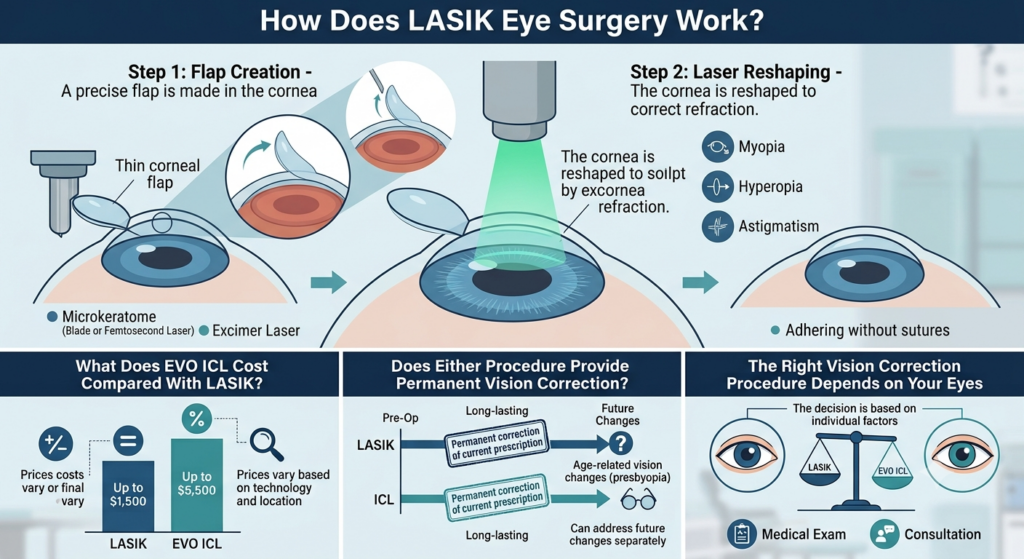
LASIK eye surgery uses laser technology to reshape the cornea so that light focuses more accurately on the retina.
At Center For Sight, a femtosecond laser creates a thin corneal flap. The surgeon then uses a laser to reshape the underlying corneal tissue before repositioning the flap. Center For Sight also offers topography-guided treatment that uses detailed measurements of the corneal surface to customize the procedure.
What Can LASIK Correct?
LASIK can be used to correct:
- Nearsightedness
- Farsightedness
- Astigmatism
Candidacy depends on more than prescription strength. Corneal thickness and shape, prescription stability, tear-film health, age, and overall eye condition all need to be evaluated.
How Does EVO ICL Surgery Work?
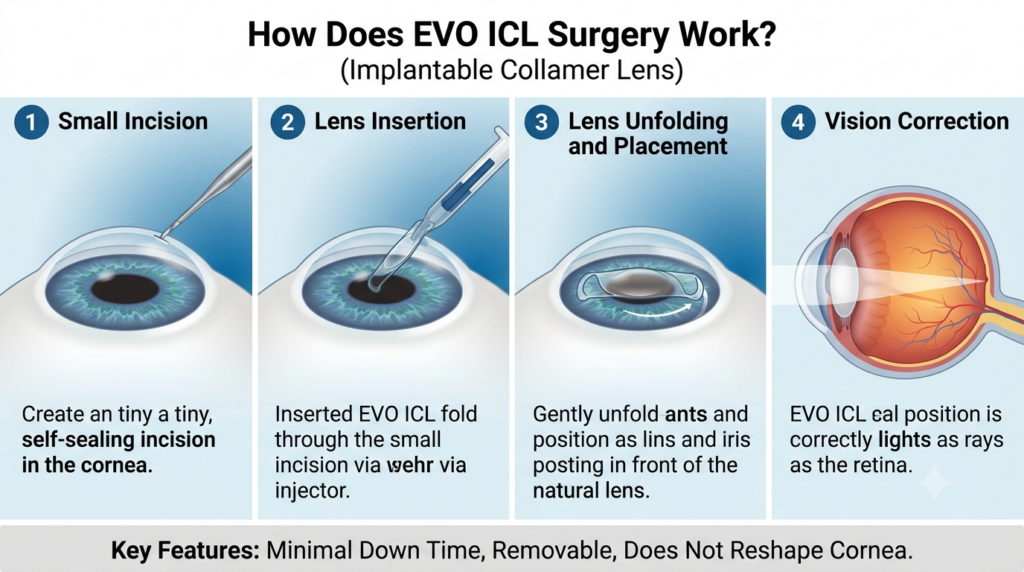
EVO ICL is an Implantable Collamer Lens placed behind the iris and in front of the eye’s natural lens. The surgeon inserts the lens through a small incision, and no corneal tissue needs to be removed.
The lens remains inside the eye to provide long-term vision correction. Unlike the changes caused by LASIK, the EVO ICL can be surgically removed or replaced if necessary.
What Can EVO ICL Correct?
In the United States, EVO ICL is approved for correcting or reducing myopia from -3.0 to -20.0 diopters. The toric version can also treat qualifying myopic astigmatism.
Recently, the FDA-approved age indication expanded from ages 21–45 to 21–60. Candidates must also meet requirements involving prescription stability, anterior chamber depth, endothelial cell density, and overall eye health.
EVO ICL does not currently provide the same treatment option for farsightedness that LASIK can offer.
LASIK Pros and Cons
LASIK offers a long clinical history, rapid visual recovery, and the ability to correct several common refractive errors. There is also no implant left inside the eye.
Because LASIK reshapes the cornea, patients need sufficient healthy corneal tissue. Temporary dry eye symptoms are common after surgery, and other potential risks include glare, halos, undercorrection, overcorrection, flap complications, and rare corneal weakening.
EVO ICL Pros and Cons
EVO ICL preserves corneal tissue and can treat a broad range of nearsighted prescriptions. This can make it worth considering for some patients who are not ideal candidates for corneal laser surgery.
EVO ICL is an intraocular procedure, however, so its risks are different from LASIK. Potential complications include increased eye pressure, inflammation, cataract formation, endothelial cell loss, retinal complications, and the possibility that the lens may need to be repositioned, exchanged, or removed.
Who Is a Good Candidate for LASIK?
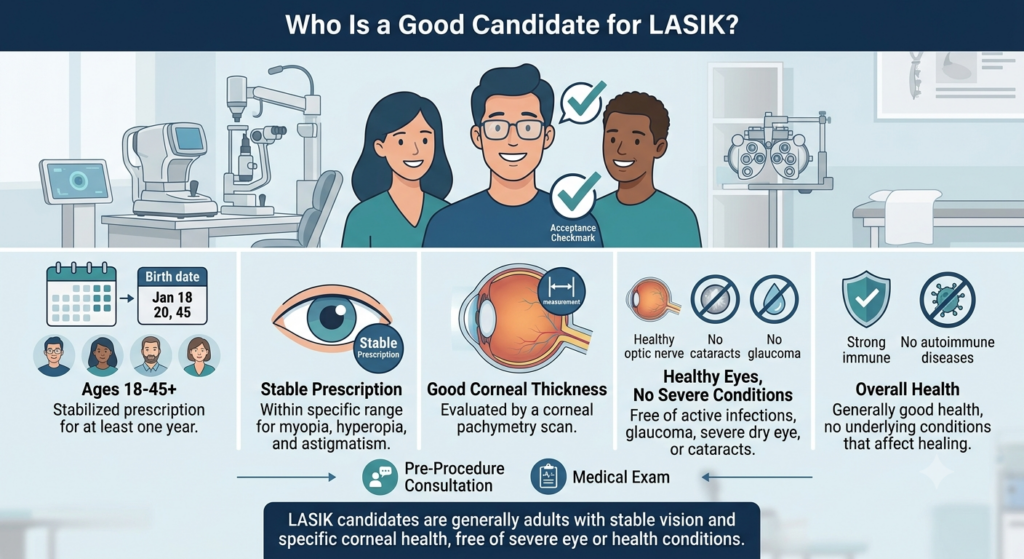
LASIK may be an option for adults who have a stable prescription and whose eye measurements show that laser vision correction can be performed safely. A good candidate is determined by the overall health and structure of the eyes—not just the strength of the prescription.
What Your Surgeon Will Evaluate Before LASIK
During a LASIK consultation, your surgeon will review factors such as:
- Prescription stability: Your vision prescription should generally remain unchanged before surgery.
- Corneal measurements: Detailed scans evaluate the thickness, shape, and surface characteristics of the cornea.
- Eye health: Conditions affecting the cornea, retina, or other parts of the eye may influence whether LASIK is appropriate.
- Ocular surface health: Tear production and eye surface measurements help determine whether your eyes are suitable for surgery.
- Vision goals: Your surgeon will consider your daily activities, expectations, and long-term vision needs when recommending treatment.
LASIK is not determined by prescription alone. Two people with similar prescriptions may receive different recommendations based on their eye anatomy, measurements, and overall eye health.
If LASIK is not the right fit, your surgeon may discuss other vision correction options, such as PRK or EVO ICL, depending on your individual evaluation.
Who Is a Good Candidate for EVO ICL Surgery?
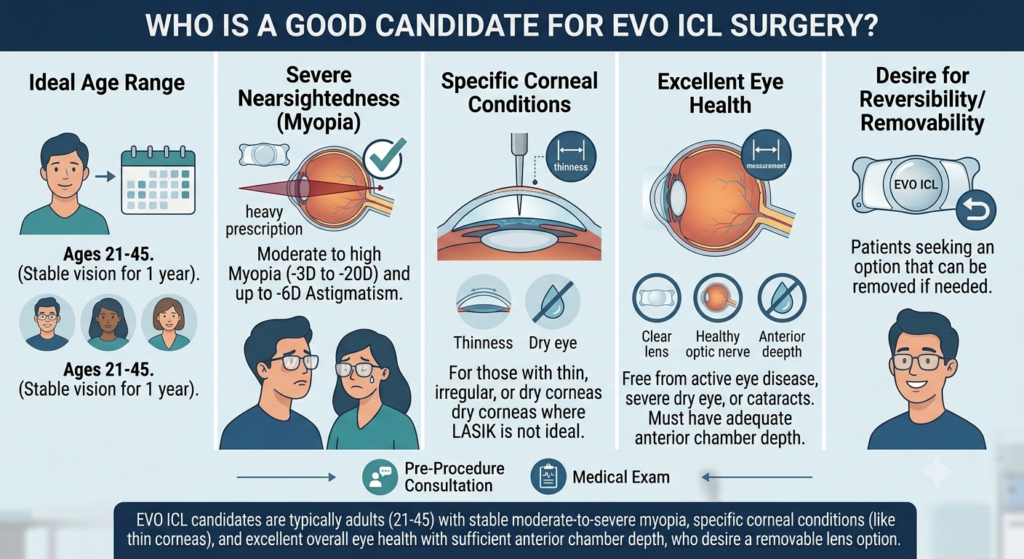
EVO ICL may be considered for adults with qualifying nearsightedness who meet specific anatomical and eye health requirements for an implantable lens. Unlike laser procedures that rely on corneal reshaping, EVO ICL candidacy is based on internal measurements of the eye and on whether there is adequate space for the lens.
What Your Surgeon Will Evaluate Before EVO ICL
Your EVO ICL consultation may include evaluation of:
- Prescription range and stability: Candidates must have qualifying myopia and a stable prescription history.
- Anterior chamber depth: Measurements help determine whether there is enough space inside the eye for lens placement.
- Endothelial cell health: The health and density of corneal endothelial cells are evaluated before surgery.
- Overall eye health: Your surgeon will check for conditions that could affect the safety or outcome of implantation.
- Long-term vision goals: Your lifestyle, expectations, and future vision needs are considered when comparing procedures.
EVO ICL may be discussed for patients with higher levels of myopia, those whose eye measurements require an alternative to corneal laser procedures, or those looking for a vision correction option that does not involve reshaping the cornea.
The current U.S. indication includes qualifying patients ages 21 through 60 with appropriate eye measurements and prescription requirements. However, age alone does not determine candidacy—your individual eye evaluation is the deciding factor.
Tip: Not being a LASIK candidate does not automatically mean you are not eligible for vision correction surgery. A comprehensive refractive evaluation can help determine whether EVO ICL, PRK, or another procedure is a better fit for your eyes.
What Does EVO ICL Cost Compared With LASIK?
EVO ICL cost varies by practice and by the details of your treatment. Because EVO ICL involves an implanted prescription lens and intraocular surgery, its cost structure differs from LASIK.
Patients should request a personalized estimate after determining whether they are candidates. Center For Sight also offers financing options for eligible patients.
Cost is worth considering, but it should come after determining which procedures can be performed safely based on your eyes.
Does Either Procedure Provide Permanent Vision Correction?
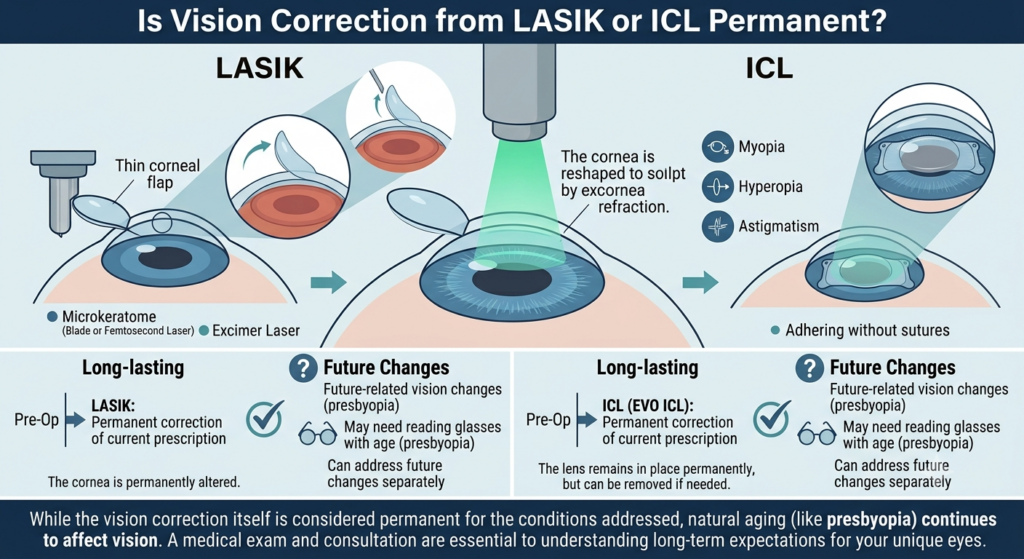
LASIK permanently changes the shape of the cornea. EVO ICL is intended to provide long-term correction, while the implanted lens can be surgically removed or exchanged.
Neither procedure prevents the eyes from changing later in life. Prescriptions can shift, and age-related changes such as presbyopia and cataracts can still develop. Some patients may eventually need reading glasses, additional vision correction, or cataract surgery regardless of which procedure they choose.
Key Takeaways
- LASIK reshapes the cornea, while EVO ICL places a corrective lens inside the eye.
- LASIK treats myopia, hyperopia, and astigmatism in qualifying patients.
- EVO ICL treats qualifying myopia with or without astigmatism and preserves corneal tissue.
- The current U.S. EVO ICL age indication extends from 21 through 60.
- EVO ICL can be surgically removed or exchanged, while LASIK’s corneal reshaping is permanent.
- Both procedures have benefits and potential risks that should be evaluated during a comprehensive refractive exam.
The Right Vision Correction Procedure Depends on Your Eyes
LASIK and EVO ICL approach vision correction differently, allowing refractive surgeons to consider more than one option for patients seeking greater freedom from glasses and contacts.
Prescription strength provides only part of the answer. Corneal anatomy, anterior chamber measurements, tear-film health, age, eye health, and long-term vision all influence which procedure may be appropriate.
A comprehensive consultation provides your surgeon with the measurements needed to compare those options and recommend a treatment tailored to your individual eyes.
Frequently Asked Questions
Is EVO ICL Better Than LASIK for Thin Corneas?
EVO ICL does not require removal of corneal tissue, which may make it an option for some patients whose corneal measurements make LASIK unsuitable. Thin corneas do not automatically make someone an EVO ICL candidate, since the procedure has its own anatomical requirements.
Can EVO ICL Be Removed Later?
Yes. An EVO ICL can be surgically removed or exchanged. Removal requires another intraocular procedure and should only be performed when recommended by an eye surgeon.
Can I Have Cataract Surgery After LASIK or EVO ICL?
Yes. Patients can undergo cataract surgery later in life after either procedure. An EVO ICL can be removed when appropriate, while patients who previously had LASIK need measurements that account for their altered corneal shape when planning cataract surgery.
Will I Still Need Reading Glasses After LASIK or EVO ICL?
Possibly. Neither procedure stops presbyopia, the age-related loss of near focusing ability that commonly becomes noticeable in middle age. Your eye doctor can explain how your age and vision goals may influence the correction selected.
How Do I Know Which Procedure I Qualify For?
A refractive consultation is the only reliable way to determine candidacy. Measurements of your prescription, corneal shape and thickness, anterior chamber, tear film, and overall eye health help your surgeon determine which options can safely meet your vision goals.
Find the Right Vision Correction Option at Center For Sight
Center For Sight offers LASIK, EVO ICL, and other refractive procedures for patients seeking less dependence on glasses or contact lenses. Your consultation is designed to determine which approach fits your prescription, anatomy, and long-term vision needs.
If you are considering LASIK vs EVO ICL, meet with an experienced eye care doctor in Florida to discuss your options and receive a personalized recommendation.
Schedule a vision correction consultation with Center For Sight to learn whether LASIK, EVO ICL, or another procedure may be right for your eyes.
About Center For Sight
Center For Sight provides ophthalmology, optometry, dermatology and cosmetic surgery services to patients in Southwest Florida. The practice offers patients convenient access to nationally renowned surgeons, highly-trained, compassionate staff members and cutting-edge technology. Center For Sight’s mission is to “bring clear vision to life” through trusting relationships and the unending pursuit of excellence in eye care. For additional information and locations, visit CenterForSight.net.
About Center For Sight Foundation
The Center For Sight Foundation is a donor-advised fund maintained and operated by the Gulf Coast Community Foundation, a section 501(c)(3) organization. The fund is composed of contributions made by individual donors. David W. Shoemaker, M.D., established the Center For Sight Foundation to support the annual Mission Cataract program, which restores vision at no cost for people living at the poverty level suffering vision loss due to cataracts. For more information, visit CFSFoundation.org.